
Table of Contents
Introduction
The demand for skilled software developers continues to grow as businesses across every industry adopt digital technologies. From startups and multinational corporations to healthcare, finance, education, and e-commerce, software powers the products and services millions of people use every day.
Whether you are a school student exploring career options, a college student preparing for placements, or a working professional planning a career transition, software development offers excellent opportunities for growth, competitive salaries, and the flexibility to work across industries or even remotely.
However, many beginners feel overwhelmed by the number of programming languages, frameworks, tools, and learning resources available today. Questions such as “Where should I start?”, “Which programming language should I learn first?”, or “Do I need a computer science degree?” are common.
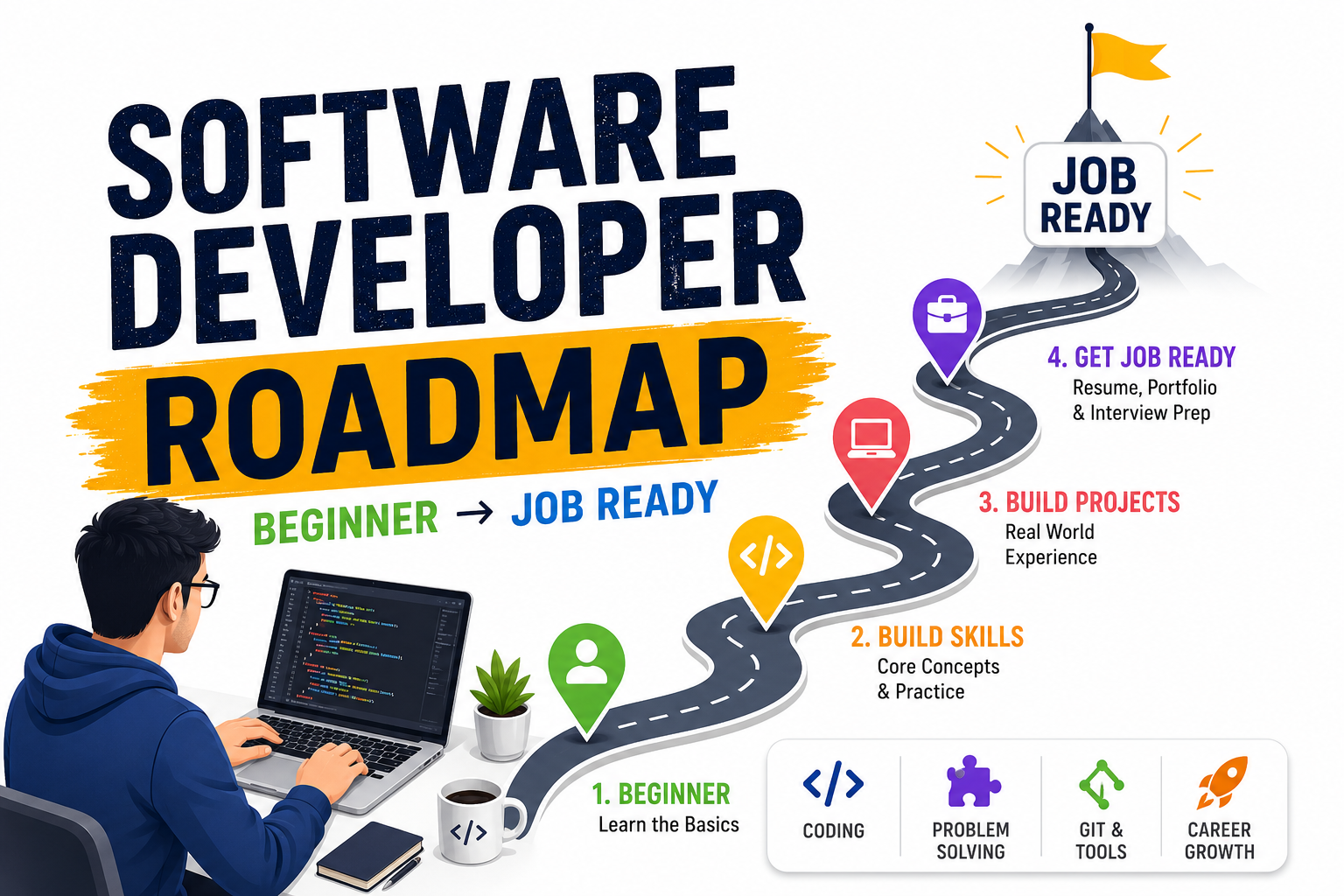
This comprehensive roadmap is designed to answer those questions and provide a clear learning path from beginner to job-ready software developer.
In this guide, you’ll learn:
- What software developers actually do
- Different software development career paths
- Essential technical and soft skills
- Programming languages worth learning
- Development tools and technologies
- Projects to build
- Salary expectations in India
- Internship and placement preparation
- A step-by-step learning roadmap
- Common mistakes to avoid
- Frequently asked questions
Whether your goal is to become a Full Stack Developer, Backend Developer, Frontend Developer, Mobile App Developer, Cloud Engineer, or AI Engineer, this roadmap will help you understand the journey ahead.
Quick Answer
A software developer is a professional who designs, builds, tests, and maintains software applications. To become a software developer in 2026, you should learn programming fundamentals, master at least one programming language, understand data structures and algorithms, build practical projects, learn Git and databases, practice coding regularly, and prepare for technical interviews. With consistent learning and hands-on experience, many beginners become job-ready within 6–12 months.
What is a Software Developer?
A software developer is someone who creates computer programs, mobile applications, websites, enterprise software, cloud services, and other digital solutions that solve real-world problems.
Software developers combine programming knowledge, logical thinking, and problem-solving skills to build reliable and efficient applications.
Their responsibilities often include:
- Writing clean and maintainable code
- Designing software architecture
- Debugging and fixing issues
- Testing applications
- Collaborating with designers and product managers
- Maintaining existing software
- Improving application performance
- Deploying software to production
Software developers work in almost every industry, including:
- Information Technology
- Banking and Finance
- Healthcare
- Education
- Manufacturing
- E-commerce
- Gaming
- Government
- Telecommunications
- Artificial Intelligence
Today, software development is not limited to large technology companies. Every modern business relies on software, creating opportunities across startups, SMEs, multinational corporations, and government organizations.
What Does a Software Developer Do?
The daily responsibilities of a software developer vary depending on their role and the company they work for. However, a typical day often includes:
Understanding Requirements
Developers begin by discussing business needs with stakeholders, understanding project goals, and planning the implementation.
Writing Code
Using programming languages such as Java, Python, JavaScript, or C#, developers write the logic that powers applications.
Testing Applications
Software is tested to identify bugs, improve reliability, and ensure everything works as expected.
Debugging
Developers investigate errors, optimize performance, and fix issues reported by users or testers.
Collaborating with Teams
Modern software development is a team effort involving designers, QA engineers, DevOps engineers, product managers, and clients.
Continuous Learning
Technology changes rapidly. Successful developers continuously learn new frameworks, tools, and best practices to stay competitive.
Types of Software Developers
Software development offers multiple career paths. Choosing one depends on your interests and long-term goals.
Frontend Developer
Frontend developers build the user interface that people interact with.
They focus on:
- Responsive websites
- User experience
- Interactive interfaces
- Accessibility
- Performance optimization
Common technologies include:
- HTML
- CSS
- JavaScript
- React
- Angular
- Vue.js
Backend Developer
Backend developers create the server-side logic behind applications.
They work with:
- APIs
- Authentication
- Databases
- Business logic
- Security
- Performance
Popular technologies include:
- Java
- Spring Boot
- Node.js
- Python
- Django
- Express.js
- .NET
Full Stack Developer
A Full Stack Developer understands both frontend and backend development.
They can build complete applications independently and are especially valuable in startups and smaller teams.
Skills include:
- Frontend frameworks
- Backend development
- Databases
- APIs
- Deployment
- Git
Mobile App Developer
These developers create applications for smartphones and tablets.
Popular technologies include:
- Kotlin
- Swift
- Flutter
- React Native
DevOps Engineer
DevOps professionals automate software deployment, infrastructure, monitoring, and cloud operations.
They commonly use:
- Docker
- Kubernetes
- AWS
- Azure
- Jenkins
- Terraform
Data Scientist
Data scientists analyze large datasets to discover insights and build predictive models.
Skills include:
- Python
- Machine Learning
- SQL
- Statistics
- Data Visualization
AI & Machine Learning Engineer
AI Engineers develop intelligent systems capable of learning from data.
They build:
- Chatbots
- Recommendation systems
- Computer vision applications
- Large Language Model (LLM) integrations
- AI automation tools
Cyber Security Engineer
Cybersecurity professionals protect systems and applications against digital threats.
They focus on:
- Ethical hacking
- Penetration testing
- Network security
- Incident response
- Risk assessment
Why Choose Software Development in 2026?
Software development remains one of the most rewarding and future-focused careers.
High Demand
Organizations across industries continue to invest in digital transformation, increasing the need for skilled developers.
Competitive Salaries
Software development offers strong earning potential with opportunities for rapid salary growth as experience and expertise increase.
Remote Work Opportunities
Many companies now offer hybrid or fully remote roles, allowing developers to work from virtually anywhere.
Continuous Learning
New technologies, frameworks, and tools keep the profession dynamic and intellectually engaging.
Global Career Opportunities
Software developers can work for companies across the world, freelance independently, or build their own products and startups.
Diverse Career Paths
From web development and mobile apps to artificial intelligence, cybersecurity, cloud computing, and game development, software development offers numerous specialization options.
Career Opportunities
As your experience grows, you can progress through roles such as:
- Software Developer
- Software Engineer
- Frontend Developer
- Backend Developer
- Full Stack Developer
- Mobile App Developer
- DevOps Engineer
- Cloud Engineer
- Data Engineer
- AI Engineer
- Machine Learning Engineer
- Solutions Architect
- Technical Lead
- Engineering Manager
- Chief Technology Officer (CTO)
With experience, many professionals also transition into entrepreneurship, consulting, freelancing, or technical education.
Skills Every Software Developer Should Learn
Becoming a successful software developer is much more than learning a programming language. Companies hire developers who can solve problems, collaborate with teams, write maintainable code, and continuously adapt to new technologies.
The skills required can be divided into two categories:
- Technical Skills (Hard Skills)
- Professional Skills (Soft Skills)
Both are equally important for building a long-term career.
Technical Skills
1. Programming Fundamentals
Before learning frameworks or advanced technologies, build a strong understanding of programming fundamentals.
You should know:
- Variables
- Data Types
- Operators
- Conditional Statements
- Loops
- Functions
- Arrays
- Strings
- Object-Oriented Programming (OOP)
- Exception Handling
Programming fundamentals remain the same regardless of whether you later work with Java, Python, JavaScript, or C#.
Pro Tip: Spend extra time mastering programming logic rather than memorizing syntax.
2. Choose Your First Programming Language
Many beginners ask:
Which programming language should I learn first?
The answer depends on your career goals.
| Language | Best For |
|---|---|
| Java | Enterprise Software, Backend Development |
| Python | AI, Machine Learning, Automation, Data Science |
| JavaScript | Frontend & Full Stack Development |
| C++ | Competitive Programming, System Programming |
| C# | Desktop Applications, Game Development (.NET, Unity) |
| Go | Cloud Applications, High Performance Services |
For most beginners, Java, Python, or JavaScript are excellent starting points.
Learn Data Structures & Algorithms (DSA)
One of the biggest differences between beginner developers and job-ready developers is problem-solving ability.
Companies evaluate this during coding interviews.
Important topics include:
- Arrays
- Strings
- Linked Lists
- Stacks
- Queues
- Trees
- Graphs
- Hash Tables
- Recursion
- Searching Algorithms
- Sorting Algorithms
- Dynamic Programming
- Greedy Algorithms
- Backtracking
Practice solving problems consistently instead of trying to learn everything in one week.
Understand Object-Oriented Programming (OOP)
Object-Oriented Programming is used in Java, C++, C#, Python, and many modern languages.
Learn these concepts thoroughly:
- Classes
- Objects
- Encapsulation
- Inheritance
- Polymorphism
- Abstraction
Most software development interviews include OOP questions.
Database Management
Every software application stores data.
A software developer should understand databases before applying for internships or jobs.
Start with SQL databases:
- MySQL
- PostgreSQL
Learn:
- SELECT
- INSERT
- UPDATE
- DELETE
- JOIN
- GROUP BY
- ORDER BY
- Indexing
- Normalization
- Transactions
After SQL, explore NoSQL databases like:
- MongoDB
- Redis
Version Control (Git & GitHub)
Professional software teams use Git every day.
Learn:
- Repository
- Commit
- Push
- Pull
- Branch
- Merge
- Pull Requests
- Conflict Resolution
GitHub allows you to:
- Showcase projects
- Collaborate with teams
- Contribute to open source
- Build a professional portfolio
A well-maintained GitHub profile often strengthens internship and job applications.
Web Development Basics
Even if your goal isn’t frontend development, understanding how the web works is valuable.
Learn:
- HTML
- CSS
- Responsive Design
- JavaScript
- Browser Basics
- REST APIs
- JSON
These concepts help you understand how users interact with applications.
Frontend Frameworks
Modern applications rarely use plain JavaScript.
Popular frontend frameworks include:
- React
- Angular
- Vue.js
For beginners interested in web development, React is a widely used choice.
Backend Development
Backend development powers the logic behind applications.
Important topics:
- REST APIs
- Authentication
- Authorization
- JWT
- Session Management
- File Uploads
- Email Services
- Database Integration
- API Security
Popular backend technologies include:
- Spring Boot (Java)
- Node.js + Express
- Django (Python)
- ASP.NET Core
APIs
Every developer should understand APIs.
Learn:
- What is an API?
- HTTP Methods (GET, POST, PUT, DELETE)
- Status Codes
- Authentication
- JSON Requests
- JSON Responses
Tools like Postman help you test APIs during development.
Cloud Computing
Cloud skills are increasingly valuable because many applications are deployed online.
Understand:
- What is Cloud Computing?
- Virtual Machines
- Object Storage
- Compute Services
- Serverless Functions
- Cloud Databases
Popular cloud providers include:
- Amazon Web Services (AWS)
- Microsoft Azure
- Google Cloud Platform (GCP)
You don’t need to become a cloud expert immediately, but understanding deployment concepts is beneficial.
DevOps Basics
Software isn’t complete until it’s deployed.
Learn:
- Docker
- Kubernetes (Basics)
- CI/CD
- GitHub Actions
- Jenkins
- Nginx
- Linux Commands
These tools improve deployment and automation skills.
System Design
As you gain experience, companies expect you to understand scalable software architecture.
Beginner topics include:
- Client-Server Architecture
- Load Balancers
- Databases
- Caching
- Microservices
- Message Queues
- CDN
- Scalability
System design is especially important for mid-level and senior roles.
Software Development Tools
Professional developers use various tools to improve productivity.
Common tools include:
| Tool | Purpose |
|---|---|
| VS Code | Code Editor |
| IntelliJ IDEA | Java Development |
| Android Studio | Android Development |
| Git | Version Control |
| GitHub | Code Hosting |
| Postman | API Testing |
| Docker | Containerization |
| Figma | UI Collaboration |
| Jira | Project Management |
| Slack | Team Communication |
You don’t need to master every tool immediately—learn them as your projects require.
Soft Skills Every Developer Needs
Technical knowledge alone isn’t enough.
Strong professional skills help developers work effectively in teams.
Communication
Developers regularly discuss ideas with teammates, managers, and clients. Clear communication reduces misunderstandings and improves collaboration.
Problem-Solving
Software development is fundamentally about solving problems. Break large problems into smaller tasks and approach them logically.
Teamwork
Modern software projects involve designers, testers, DevOps engineers, and product managers. Being a supportive team member is essential.
Time Management
Meet deadlines, prioritize tasks, and maintain a healthy balance between learning and project work.
Continuous Learning
Technology evolves rapidly. Successful developers stay curious, explore new tools, and adapt to industry changes.
Certifications (Optional)
Certifications can strengthen your profile, but they should complement—not replace—practical skills.
Consider certifications in:
- AWS Cloud
- Microsoft Azure
- Google Cloud
- Oracle Java
- Python
- Docker
- Kubernetes
- Cybersecurity
- AI & Machine Learning
Employers generally value real projects and demonstrated skills more than certifications alone.
Build a Strong GitHub Portfolio
A GitHub profile acts as your technical portfolio.
Include:
- Personal projects
- College projects
- Open-source contributions
- Well-written README files
- Clean commit history
- Proper documentation
Quality matters more than the number of repositories.
Key Takeaways
By the end of this stage, you should be comfortable with:
- ✅ One programming language (Java, Python, or JavaScript)
- ✅ Programming fundamentals
- ✅ Object-Oriented Programming
- ✅ Data Structures & Algorithms
- ✅ SQL and basic database concepts
- ✅ Git and GitHub
- ✅ HTML, CSS, and JavaScript fundamentals
- ✅ APIs and backend basics
- ✅ Cloud and DevOps fundamentals
- ✅ Professional software development tools
- ✅ Communication, teamwork, and problem-solving skills
These skills provide a strong foundation for internships and entry-level software development roles.
Software Developer Roadmap (0–12 Months)
Phase 1: Build Your Foundation (Month 1–2)
Your goal is to understand programming fundamentals.
Learn:
- Computer basics
- How the internet works
- Programming logic
- Variables
- Data Types
- Operators
- Loops
- Conditional Statements
- Functions
- Arrays
- Strings
- Object-Oriented Programming
Choose ONE Programming Language
Pick one language based on your goals:
- Java (Enterprise Development)
- Python (AI, Automation, Data Science)
- JavaScript (Web Development)
Avoid learning multiple languages at the beginning.
Practice
- Write simple programs every day.
- Solve beginner coding problems.
- Focus on understanding logic rather than memorizing syntax.
Phase 2: Learn Development Fundamentals (Month 3–4)
Once you understand programming, move on to software development concepts.
Learn
- Git
- GitHub
- SQL
- Database Design
- HTML
- CSS
- JavaScript (Basics)
- REST APIs
Build Small Projects
Examples:
- Calculator
- Student Management System
- Library Management System
- Expense Tracker
- Weather App
- Portfolio Website
The goal is to apply what you’ve learned, not build perfect applications.
Phase 3: Choose Your Specialization (Month 5–7)
After building a strong foundation, choose a career path based on your interests.
Option 1: Full Stack Development
Learn:
- React
- Node.js
- Express.js
- MongoDB or MySQL
- Authentication
- Deployment
Option 2: Java Backend Development
Learn:
- Spring Boot
- Spring Security
- Hibernate/JPA
- REST APIs
- MySQL
- Microservices (Basics)
Option 3: Python Development
Learn:
- Django or Flask
- Automation
- APIs
- Data Analysis
- Machine Learning (if interested)
Option 4: AI & Machine Learning
Learn:
- Python
- NumPy
- Pandas
- Scikit-learn
- TensorFlow or PyTorch
- Generative AI
- Prompt Engineering
- LLM Integration
Option 5: Cloud & DevOps
Learn:
- Linux
- Docker
- Kubernetes
- AWS
- CI/CD
- GitHub Actions
- Terraform (Basics)
Choose one specialization and develop deep expertise before exploring others.
Phase 4: Build Real Projects (Month 8–10)
Projects demonstrate your practical skills to employers.
Aim to complete at least 5–8 well-documented projects.
Examples:
Beginner
- Calculator
- To-Do List
- Notes App
- Currency Converter
Intermediate
- Student Management System
- Hospital Management System
- Inventory Management
- Blogging Platform
Advanced
- E-commerce Website
- Learning Management System
- CRM Software
- Food Delivery App
- Job Portal
- Real-Time Chat Application
- Video Conferencing Platform
Each project should include:
- Clean code
- GitHub repository
- README documentation
- Screenshots
- Live deployment (if possible)
Phase 5: Internship Preparation (Month 10–11)
Internships help you gain industry experience and improve employability.
Before applying, ensure you have:
- A professional resume
- Updated LinkedIn profile
- Active GitHub account
- Portfolio website (optional but valuable)
- 5–8 projects
- Strong programming fundamentals
Practice:
- Coding challenges
- Aptitude tests
- Technical interviews
- Communication skills
Phase 6: Job Preparation (Month 11–12)
Focus on interview readiness.
Revise:
- Programming language fundamentals
- OOP
- SQL
- DSA
- APIs
- Databases
- Operating Systems (Basics)
- Computer Networks (Basics)
Practice mock interviews and continue solving coding problems regularly.
Recommended Projects
Employers often value practical experience over certificates.
Consider building:
Web Development
- Personal Portfolio
- Blogging Platform
- E-commerce Store
- Online Course Platform
- CRM Dashboard
Java
- Banking System
- Employee Management
- Inventory Management
- Hospital Management
Python
- Expense Tracker
- AI Chatbot
- Data Analysis Dashboard
- Automation Scripts
AI
- Resume Screening Tool
- Chatbot
- Recommendation System
- Image Classifier
Build Your Portfolio
Your portfolio should highlight your best work.
Include:
- Introduction
- Skills
- Projects
- GitHub
- Resume
- Contact Information
Keep it simple, responsive, and easy to navigate.
Resume Checklist
A strong resume should include:
- Professional Summary
- Technical Skills
- Projects
- Education
- Certifications (if applicable)
- Internships
- Achievements
- GitHub
Tailor your resume for each role instead of sending the same version everywhere.
Interview Preparation
Most software developer interviews include:
Technical Round
Topics:
- Programming
- OOP
- SQL
- APIs
- Databases
- DSA
Coding Round
Practice:
- Arrays
- Strings
- Trees
- Graphs
- Dynamic Programming
- Binary Search
Use coding platforms consistently rather than solving many problems in one sitting.
HR Round
Common questions include:
- Tell me about yourself.
- Why do you want to join our company?
- What are your strengths?
- Describe a challenging project you worked on.
- Where do you see yourself in five years?
Prepare thoughtful, authentic responses.
Software Developer Salary in India (2026)
Salary depends on skills, location, company, and experience.
| Experience | Typical Annual Salary (Approx.) |
|---|---|
| Internship | ₹10,000–₹40,000/month |
| Fresher (0–1 Year) | ₹3–8 LPA |
| 2–5 Years | ₹8–18 LPA |
| 5–10 Years | ₹18–35+ LPA |
| Senior Roles | ₹35 LPA and above |
Exceptional candidates at top product companies may earn significantly more through higher compensation packages.
Common Mistakes Beginners Make
Avoid these common pitfalls:
- Learning too many programming languages at once.
- Watching tutorials without building projects.
- Ignoring Git and GitHub.
- Avoiding DSA completely.
- Copy-pasting code without understanding it.
- Focusing only on certificates.
- Applying for jobs without a portfolio.
- Inconsistent practice.
- Neglecting communication skills.
- Giving up after rejections.
Consistency matters more than speed.
Frequently Asked Questions
Can I become a software developer without a Computer Science degree?
Yes. Many successful developers come from non-CS backgrounds. Employers generally prioritize skills, projects, and problem-solving ability.
How long does it take to become job-ready?
With consistent effort, many learners become ready for internships or entry-level roles within 6–12 months.
Which programming language is best for beginners?
Java, Python, and JavaScript are all strong choices. Choose one based on your career goals and master it before learning others.
Do I need DSA?
DSA is important for coding interviews and problem-solving, especially for many software engineering roles.
Should I learn AI before web development?
Not necessarily. Build strong programming fundamentals first, then specialize based on your interests.
Are certifications necessary?
Certifications can add value, but employers usually place greater emphasis on projects, practical skills, and interview performance.
Final Thoughts
Software development is one of the most rewarding careers because it combines creativity, logical thinking, and continuous learning. The journey may seem challenging at first, but every expert developer started by writing their first line of code.
Focus on mastering the fundamentals, building meaningful projects, contributing to your GitHub portfolio, and practicing consistently. Avoid comparing your progress to others; steady improvement over time is what leads to long-term success.
Remember, becoming a software developer isn’t about learning every technology—it’s about learning how to solve problems effectively and adapting as technology evolves.
Key Takeaways
- Learn one programming language thoroughly before moving to others.
- Build a strong foundation in programming, OOP, SQL, Git, and DSA.
- Create 5–8 real-world projects with proper documentation.
- Develop a professional GitHub profile and resume.
- Practice coding and interview questions regularly.
- Stay curious and continue learning throughout your career.
Ready to Start Your Journey?
If you’re looking for structured guidance, real-world projects, coding practice, technical assessments, internships, and career support, explore LABSITY’s Software Development ecosystem.
Whether you’re starting from scratch or preparing for placements, LABSITY provides the resources to help you become a confident, job-ready software developer.
Rishabh Malviya
SDE 3 at Amazon
13+ yrs of experience in Software Engineering, developing enterprise application, worked in scaling Alexa (R&D)
